
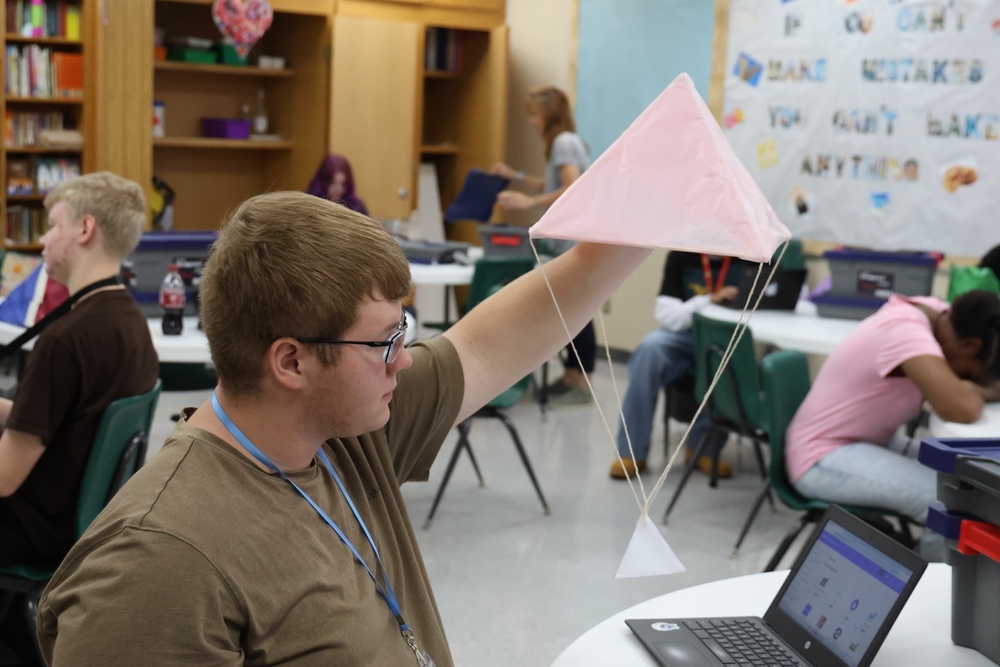
It was an experiment of which Leonardo da Vinci himself would have been proud.
Almost 550 years after the great engineer and scientist sketched out his idea for a parachute, students in the Aviation I class at the Life Ready Center brought his design to life. Known as the da Vinci parachute, the design resembles a pyramid canopy more than the dome shape of the modern era.
“It’s actually not a super effective design, but da Vinci was one of the first documented innovators to actually think about human flight on this level,” said aviation teacher Brooke Rooney.
Students were asked to replicate da Vinci’s design simply by looking at it, Rooney said. She offered no instructions and no guidance. Students used tissue paper, wooden dowel rods, string, hot glue and Scotch tape — materials that would not have been available to da Vinci. They also had to add some cargo.
“The kicker was that their parachute had four sides and their cargo box only had three,” Rooney said. “They had to figure out how to get their cargo balanced enough for the parachute to fall evenly. The weight of the wooden dowels makes them heavy, and the imbalance of the cargo makes them unsturdy.”
The greatest challenge may have been the materials themselves.
“It was a little challenging, but kinda fun and easy to make,” said William Atkinson, noting that tissue paper tears easily. “We watched a video demonstration and tried to craft our own.”
Aiden Huynh agreed that working with tissue paper was the hardest part.
“It can be too short or too long,” Huynh said as he used Scotch tape to attach his blue tissue paper to the dowel rods.
Students also had to design a package of cargo, in a pyramid shape, that held three pennies and was attached to the parachute by string.
“The parachute should slow-fall so when the cargo hits the ground, it shouldn’t be damaged,” Atkinson said. Atkinson said he solved his cargo problem by placing a penny in each corner to keep the parachute from tilting or falling incorrectly.
Once the parachutes were assembled, it was time to test them. Rooney collected the chutes, climbed to the roof of the Life Ready Center, and dropped them one by one over the side. Most of the colorful parachutes floated gently to the ground.
Huynh said his parachute flipped over.
“My strings were uneven. I would say the cargo survived at least,” he said. He also learned how to make a frame that will support itself in the wind.
Arvon Lewis said his parachute went the farthest in terms of distance, but he thought it could have been balanced better. He said he had learned about using the wrong materials “before getting into more serious things later.”
Lewis, who has been sampling different career paths at the Life Ready Center, has taken engineering, construction and now aviation.
“Construction was fun,” Lewis said, adding that is where he learned he did not like the assembly line technique. “Engineering was more of a mental challenge. It allows you new ways of thinking and developing whatever your idea is. Engineering allows you more creativity and is more engaging mentally.”
He said he and another student made the da Vinci parachute together.
“It was a fun project. It was good to jump start the year,” he said.
Rooney said the parachute activity was more of a history lesson.
“Later, we talk about parachutes again. That’s when they’ll design their own,” she said.
The next project will be designing their own hot air balloons out of, what else — tissue paper.