
After two days of playing Indigenous games, some students at Lawton Public Schools’ Makerspace Camp had worked up an appetite.
Dan Ninham, a member of the Oneida tribe in Minnesota, had just the thing — a bowlful of Three Sisters Soup served with wild rice and cornbread and some strawberry water to wash it all down. There was just one catch; the students had to help prepare the meal.
The 10 students were actually enrolled in the culinary class at Makerspace Camp but Ninham, who was a guest presenter, first introduced them to some Indigenous games they had never played before. Then it was time to cook.
Ninham chose two Native American dishes for the students to prepare, and offered some background on the dishes. He said Three Sisters Soup is so named because of the way tribes grew corn, beans and squash, which are the main ingredients in the soup. He explained that tribes created a mound of dirt on which they planted corn. When the corn was about 6 inches tall, they planted pole beans, so named because they twine around a pole. Lastly, they planted squash, whose large leaves served as an umbrella over the plants against the hot sun.
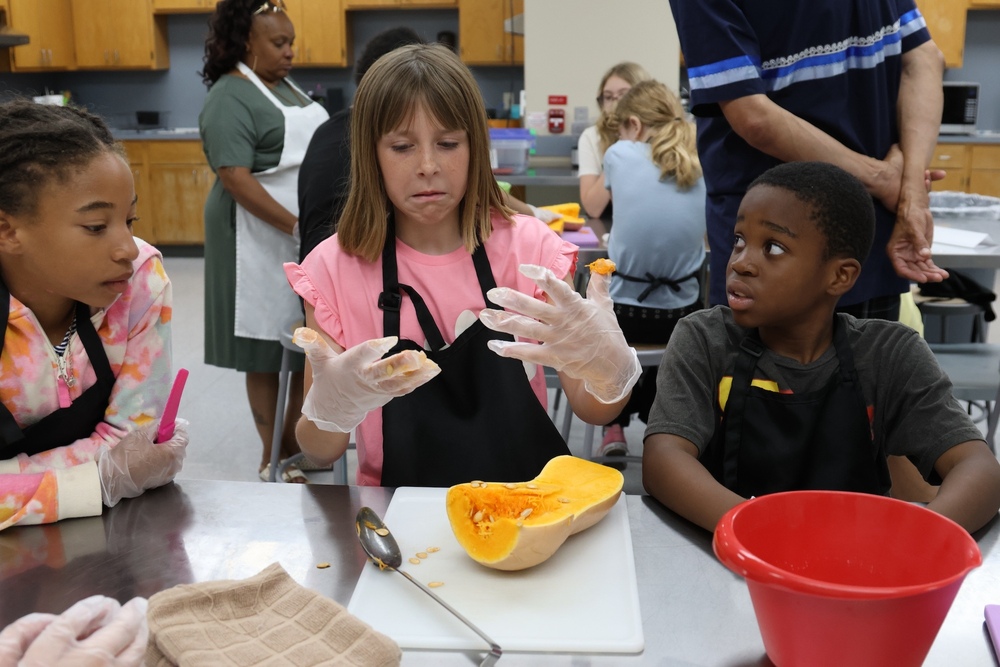
Students started their cooking adventure by scooping out the seeds inside two butternut squashes that were split in half. Harmoni Imler was one of those chosen to scoop out the seeds either by hand or by using a spoon. She opted to use her gloved hands first before trying a spoon.
“It felt nasty. I had some help. Scooping it out was hard. It was slippery,” Imler said after the experience. Her friend, Kassidy Zapata, helped her hold half of the squash as Imler tried to remove the seeds.
Once the two butternut squashes were sufficiently deseeded, they were placed on cookie sheets and placed in the oven to bake while students prepared the other soup ingredients. Students added cans of red kidney beans and black beans to pots on the stove. Mexican-style hominy was the next to go in, along with some vegetable broth and a small can of green chiles.
Ninham then led students through the steps to make cornbread with fresh blueberries. The last dish was wild rice, which came with a lesson on harvesting rice.
Ninham said in Minnesota, where he is from, rice is still harvested the traditional way by two people in a canoe. The person in the back pushes the canoe through the rice stalks while the person in front uses two poles — one to bend the rice stalks over and the other to gently tap the rice grains out of the stalks and into the bottom of the canoe.
Students then took turns rinsing the rice, which Ninham said needed to be done at least seven times until the rinse water was clear. Once the rice was ready, it was put on the stove to cook; when it was done, some frozen blueberries were added.
After the squashes were done, some were cut into chunks and added to the bean mixture simmering on the stove.
“It looks good,” Izzy Ballard said as she stirred the soup. “It’s a new food. I like to try new things.” Ballard said she likes to cook at home, where she helps stir, cut and peel items. She said she also makes “easy stuff” like eggs, hot dogs and pancakes.
Chunks of squash not put in the soup were given to students for a taste test.
Dakota Wilkie said it was her first time to eat butternut squash and pronounced it “really good. I thought it was going to taste like pumpkin, but it has its own flavor.”
She predicted the soup would taste good as well. “I love squash. It is my favorite vegetable,” she said.
While students waited for their meal to cook, they sliced strawberries for their strawberry water.
Then came the moment of truth. How did everything taste?
Students lined up for helpings of soup, cornbread and wild rice, to which Ninham suggested they add a drizzle of maple syrup.
“The soup is kind of sweet somehow,” Elena Martin said. “The cornbread is weird, but it’s good. The rice is different with blueberries in it, but it is good.”
Martin was hesitant but added some maple syrup to the wild rice mixture, which she said was better with the syrup.
“I don’t know why. It’s a really savory aftertaste,” she said.
Kassidy Zapata predicted the cornbread was “going to taste really good. My parents only make cornbread. They don’t add stuff like blueberries. I will probably ask my parents to get some to make.”
The strawberry water also was something new for the students’ tastebuds.
“It was sweet and savory,” Ballard said as she drank some before fishing a strawberry out of her cup with her teeth.
Which activity did the students enjoy most, playing games or cooking?
“The games are very tiring,” Martin said. “Cooking is quiet for me.”
The meal also served as a cultural lesson. What had Zapata learned?
“A lot of food that is unique to other states,” she said. “They hunted a lot for their families.”
The lesson about hunting food for their families was reinforced the next day when sloppy joes made with bison meat were on the menu for students to prepare.
Makerspace Camp is provided by Lawton Public Schools in partnership with Arts for All Summer Institute.