
Nine routes. Thirty school district employees. Eighty happy families.
Lawton Public Schools ended its Fall 2025 semester Friday in what has been a tradition for more than 50 years: distributing boxes of perishable and non-perishable food items to 80 district families to make sure they have food during the two-week holiday break – especially on Christmas.
Shoemaker Education Center was a beehive of activity early Friday as district employees put the finishing touches on the Christmas Food Baskets program, checking and aligning cardboard boxes that had been lining corridors for days, comparing lists, and ensuring that each vehicle delivering food had the proper amount of supplies. By 8:30 a.m. the building was quiet again; all boxes had been loaded and nine delivery teams had begun running their routes.
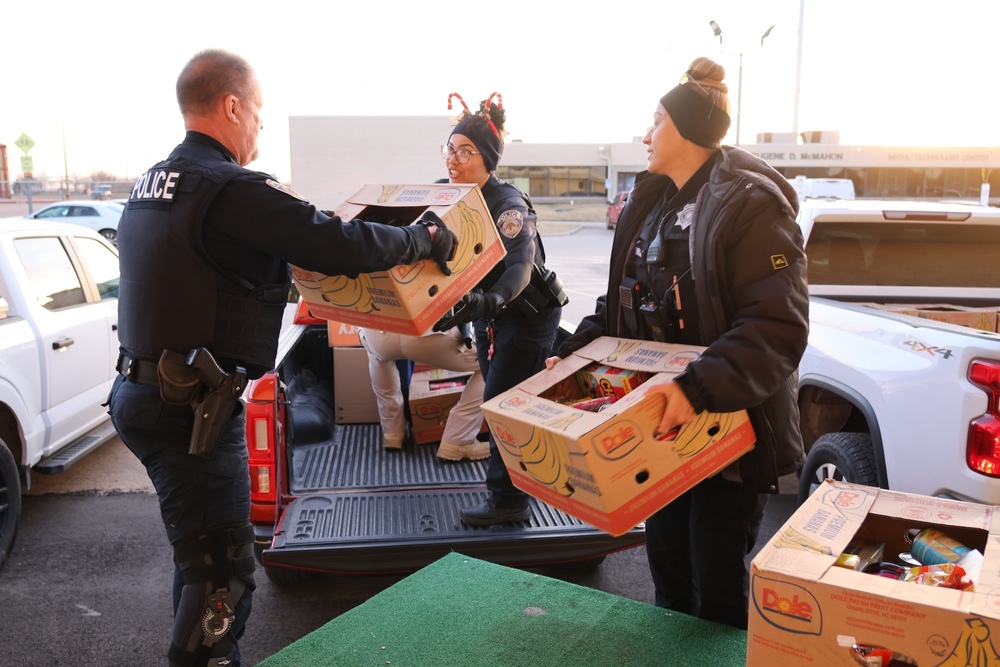
Schyla Brown, who coordinates the food basket program, said the project is a labor of love and is completely LPS driven, from donations of non-perishable food items by district employees and $2 per employee donations to pay for perishable items, to the MacArthur High Junior ROTC students who assembled the donations into boxes, to the LPS police who loaded the boxes into waiting vehicles, to the drivers and “elves” who delivered boxes to each family.
The reason has remained consistent over five decades.
“The district saw a need,” Brown said, explaining the program was created because school administrators knew there were students who would face food uncertainty during the two-week Christmas break and probably wouldn’t have a real holiday meal.
Coordination has a military-like precision.
Work begins in late October when each school site is asked to identify three families who will need help with food over Christmas. Brown said each school site also is responsible for collecting one non-perishable food item – enough for all 80 boxes – noting, for example, that the employees of Shoemaker Center were responsible for peanut butter. Perishable items (such as ham and potatoes) are paid for by the $2 that each district employee is asked to contribute.
Brown said perishable items will become Christmas dinner, while the non-perishable items are designed to provide easy food preparation by students. That’s why items such as ramen noodles, pasta and peanut butter are important.
“It means a child at home can prepare food for himself or younger siblings,” she said.
Coordination has always been important, and has been refined to a fine art over the years. Where once the adults got together to assemble food boxes, that duty now is done by the Junior ROTC cadets at MacArthur High.
“They did all 80 (boxes) in about 45 minutes,” Brown said, marveling at the quick efficiency of filling food boxes that were delivered to Shoemaker Center in the last week of school.
Brown and Jack Hanna, LPS’ executive director of maintenance, sat down to look at the addresses of this year’s participating families, organizing addresses into nine routes assigned to nine delivery crews.
“Jack and I split the routes by segments of the city,” Brown said, explaining the goal was getting the boxes delivered by lunchtime.
The delivery crews are volunteers, and most will tell you it is a labor of love.
Hanna is one, and his participation dates back more than 30 years. Hanna said he was a college student on Christmas break in 1991 when he got a call from former Superintendent Bud Braddy, who asked what he was doing. When Braddy found out his former student wasn’t doing anything in particular, he “invited” Hanna to come down, telling him “I have something for you to do,” Hanna remembers with a grin.
He was immediately hooked.
“I understood the magnitude of doing it,” he said, adding his role in the program has evolved over the years. “I got hooked real quick.”
When Hanna began teaching, he got football players to help separate and pack the boxes, trimming what had been days of labor to hours. He has long been involved in planning and in route deliveries, and said some of his fondest memories are spending the morning with older educators, talking as they drove. Like many other participants, his enthusiasm spread.
Hanna’s wife and children have participated in the program for years; his college-age daughter, home on holiday break, was on a delivery crew on Friday.
“She still comes back to help out,” Hanna said, adding the program is a family tradition whose payoff is the heartfelt gratitude they see in the eyes of those families. “I wouldn’t give it up. And, it’s important to us as a family.”
Skeeter Sampler, director of secondary education, said he has been involved from the other side – identifying families and collecting food items – but this year was his first working delivery routes, actually bringing food boxes to families.
“Today is full circle,” he said of the effort that let him witness the effect the project has on LPS families. “Small contributions make a huge difference.”
Adam McPhail, director of WorkForce Development, agreed, saying small efforts by all buildings and all employees add up to huge benefits for district families.
“It’s fun to see what all the sites have done separately come together,” he said, adding he also has been touched by actually seeing the families the district is helping.
LPS administrators say it is efforts like this – ones that involve the entire LPS staff and students as well – that make the program important and ensure it continues every year.